DIOSES TRIBALES
MEXICAN TRIBAL
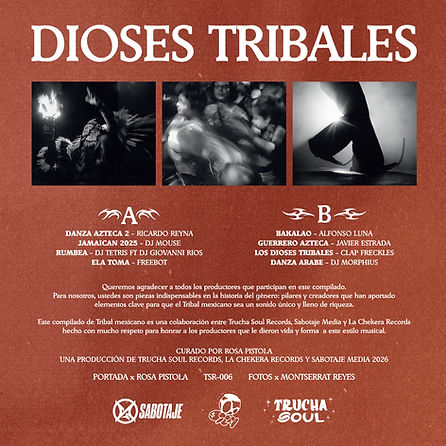
This compilation vinyl brings together some of the key pillars of Mexican tribal and celebrates the artists who helped shape one of the most distinctive languages in electronic music made in Mexico. Produced by Sabotaje Media, Trucha Sound, and La Chekera Rec, the record works as a physical archive of its history, connecting generations, territories, and visions that have kept the genre alive and in motion.

.jpeg)
This vinyl compilation brings together some of the key pillars of Mexican tribal and celebrates the artists who helped shape one of the most distinctive languages in electronic music made in Mexico. Produced by Sabotaje Media, Trucha Sound, and La Chekera Rec, the record functions as a physical archive of the genre's history, connecting generations, territories, and artistic visions that have kept Mexican tribal alive and in constant transformation.
Rather than presenting a definitive history, Dioses Tribales traces a constellation of artists whose work has been fundamental to the development of the genre. Each contribution reflects a different moment, geography, and perspective, revealing how Mexican tribal evolved through shared ideas, local identities, and continuous experimentation.
Mexican tribal emerged from a generation's desire to represent its own surroundings through the language of club music. Many of its producers came from sonidero and sound-system traditions, adapting influences from house, circuit, and EDM while filtering them through distinctly Mexican rhythmic, cultural, and sonic references. The result was a uniquely local form of electronic music that would eventually become recognized far beyond Mexico.
Among DJs and producers, the track most often cited as the first canonical work of Mexican tribal is "Danza Azteca" (2003) by Ricardo Reyna. After years producing custom remixes for DJs, Reyna sought increasingly unexpected rhythmic combinations. Inspired by witnessing concheros (Mexica dancers) performing ceremonies in Coyoacán, he fused pre-Hispanic percussion, chants, and ceremonial atmospheres with house rhythms and bass-driven club music, establishing a blueprint that would influence an entire generation.
One of the earliest DJs to embrace Reyna's experiments was DJ Mouse, who quickly recognized the originality of this emerging sound. His productions and performances helped establish Mexican tribal as a recognizable musical language, making him one of the genre's foundational figures.
While Danza Azteca became an early landmark, the dialogue between electronic instruments and Indigenous musical traditions had already begun decades earlier. During the 1980s, pioneering composer Jorge Reyes developed an extensive body of work combining synthesizers with pre-Hispanic instrumentation, Indigenous chants, and ritual percussion, imagining electronic interpretations of Mexico's ancestral soundscapes. His work remains an important cultural reference for later generations of producers.
This lineage continued in Monterrey through producers such as Javier Estrada, whose influential sample libraries and production tutorials became essential learning tools for countless emerging tribaleros. His educational work helped standardize many of the sounds that would define the genre's vocabulary.
That same ancestral current is represented in this compilation by Alfonso Luna, whose productions remain deeply devoted to pre-Hispanic sonorities while constantly negotiating between ritual, tradition, and contemporary electronic production.
Another branch of Mexican tribal flourished in northern Mexico. In Monterrey, producers incorporated elements of regional Mexican music and huapango, creating a style characterized by exuberant melodies, rapid tempos, and unmistakable rhythmic energy. Among its leading figures is DJ Morphius, whose productions, including the iconic "La Cumbia Tribalera", became defining works of this regional sound.
Representing the southern coast of Oaxaca, DJ Tetris introduced a more melodic sensibility into tribal. At a time when much of the genre relied primarily on samples, his productions increasingly incorporated vocal collaborations, expanding both the emotional range and accessibility of Mexican tribal while reaching wider audiences.
The compilation takes its title from "Dioses Tribales", the contribution by Monterrey producer Clap Freckles. Representing the second generation of tribaleros, his work preserves the foundations of classic Mexican tribal while pushing the genre toward more experimental territories, incorporating elements of ambient music, noise, and highly detailed sound design.
Completing the compilation is Freebot, also from Monterrey, representing a newer generation shaped by Javier Estrada's tutorials and sample packs. His productions embody the genre's continued evolution through hyper-accelerated BPMs, dry techno-inspired kick drums, and arrangements influenced by contemporary EDM, demonstrating how Mexican tribal continues to reinvent itself while remaining rooted in its original identity.
Taken together, the artists featured on Dioses Tribales reveal a musical lineage that stretches across generations and geographies. Each track represents a different chapter in the genre's evolution, yet together they form a coherent narrative of innovation, cultural memory, and community.
ROSA PISTOLA
Este compilado en vinilo reúne a algunos de los pilares clave del tribal mexicano y celebra a los artistas que ayudaron a dar forma a uno de los lenguajes más distintivos de la música electrónica hecha en México. Producido por Sabotaje Media, Trucha Sound y La Chekera Rec, el disco funciona como un archivo físico de la historia del género, conectando generaciones, territorios y visiones artísticas que han mantenido vivo al tribal mexicano y en constante transformación.
Más que presentar una historia definitiva, Dioses Tribales traza una constelación de artistas cuyo trabajo ha sido fundamental para el desarrollo del género. Cada contribución refleja un momento, una geografía y una perspectiva distinta, revelando cómo el tribal mexicano evolucionó a través de ideas compartidas, identidades locales y una experimentación continua.
El tribal mexicano surgió del deseo de una generación por representar su propio entorno a través del lenguaje de la música de club. Muchos de sus productores venían de tradiciones sonideras o de sound system, adaptando influencias del house, el circuit y el EDM, pero filtrándolas a través de referencias rítmicas, culturales y sonoras profundamente mexicanas. El resultado fue una forma de música electrónica única y local, que eventualmente sería reconocida mucho más allá de México.
Entre DJs y productores, el track más citado como la primera obra canónica del tribal mexicano es “Danza Azteca” (2003), de Ricardo Reyna. Después de años produciendo remixes personalizados para DJs, Reyna comenzó a buscar combinaciones rítmicas cada vez más inesperadas. Inspirado al ver a concheros (danzantes mexicas) realizando ceremonias en Coyoacán, fusionó percusiones prehispánicas, cantos y atmósferas ceremoniales con ritmos house y música de club impulsada por bajos, estableciendo un modelo que influiría en toda una generación.
Uno de los primeros DJs en adoptar los experimentos de Reyna fue DJ Mouse, quien rápidamente reconoció la originalidad de este sonido emergente. Sus producciones y presentaciones ayudaron a establecer el tribal mexicano como un lenguaje musical reconocible, convirtiéndolo en una de las figuras fundacionales del género.
Aunque “Danza Azteca” se convirtió en un punto de referencia temprano, el diálogo entre instrumentos electrónicos y tradiciones musicales indígenas ya había comenzado décadas antes. Durante los años ochenta, el compositor pionero Jorge Reyes desarrolló una extensa obra que combinaba sintetizadores con instrumentación prehispánica, cantos indígenas y percusión ritual, imaginando interpretaciones electrónicas de los paisajes sonoros ancestrales de México. Su trabajo sigue siendo una referencia cultural importante para generaciones posteriores de productores.
Esta línea continuó en Monterrey a través de productores como Javier Estrada, cuyas influyentes librerías de samples y tutoriales de producción se convirtieron en herramientas esenciales de aprendizaje para innumerables tribaleros emergentes. Su trabajo educativo ayudó a estandarizar muchos de los sonidos que definirían el vocabulario del género.
Esa misma corriente ancestral está representada en este compilado por Alfonso Luna, cuyas producciones se mantienen profundamente dedicadas a las sonoridades prehispánicas, mientras negocian constantemente entre el ritual, la tradición y la producción electrónica contemporánea.
Otra rama del tribal mexicano floreció en el norte de México. En Monterrey, productores incorporaron elementos de la música regional mexicana y el huapango, creando un estilo caracterizado por melodías exuberantes, tempos rápidos y una energía rítmica inconfundible. Entre sus figuras principales se encuentra DJ Morphius, cuyas producciones —incluyendo la icónica “La Cumbia Tribalera”— se convirtieron en obras definitivas de este sonido regional.
Representando la costa sur de Oaxaca, DJ Tetris introdujo una sensibilidad más melódica dentro del tribal. En una época en la que gran parte del género dependía principalmente de samples, sus producciones comenzaron a incorporar cada vez más colaboraciones vocales, ampliando tanto el rango emocional como la accesibilidad del tribal mexicano, y alcanzando audiencias más amplias.
El compilado toma su título de “Dioses Tribales”, la contribución del productor regiomontano Clap Freckles. Representando a la segunda generación de tribaleros, su trabajo preserva las bases del tribal mexicano clásico mientras empuja el género hacia territorios más experimentales, incorporando elementos de ambient, noise y un diseño sonoro altamente detallado.
Completando el compilado está Freebot, también de Monterrey, quien representa a una nueva generación formada por los tutoriales y sample packs de Javier Estrada. Sus producciones encarnan la evolución continua del género a través de BPMs hiperacelerados, bombos secos inspirados en el techno y estructuras influenciadas por el EDM contemporáneo, demostrando cómo el tribal mexicano sigue reinventándose sin dejar de estar arraigado en su identidad original.
En conjunto, los artistas reunidos en Dioses Tribales revelan una genealogía musical que se extiende a través de generaciones y geografías. Cada track representa un capítulo distinto en la evolución del género, pero juntos construyen una narrativa coherente de innovación, memoria cultural y comunidad.
ROSA PISTOLA

